
Coastal Sentinels: The Architectural Lore of Uluwatu’s Clifftop Temples
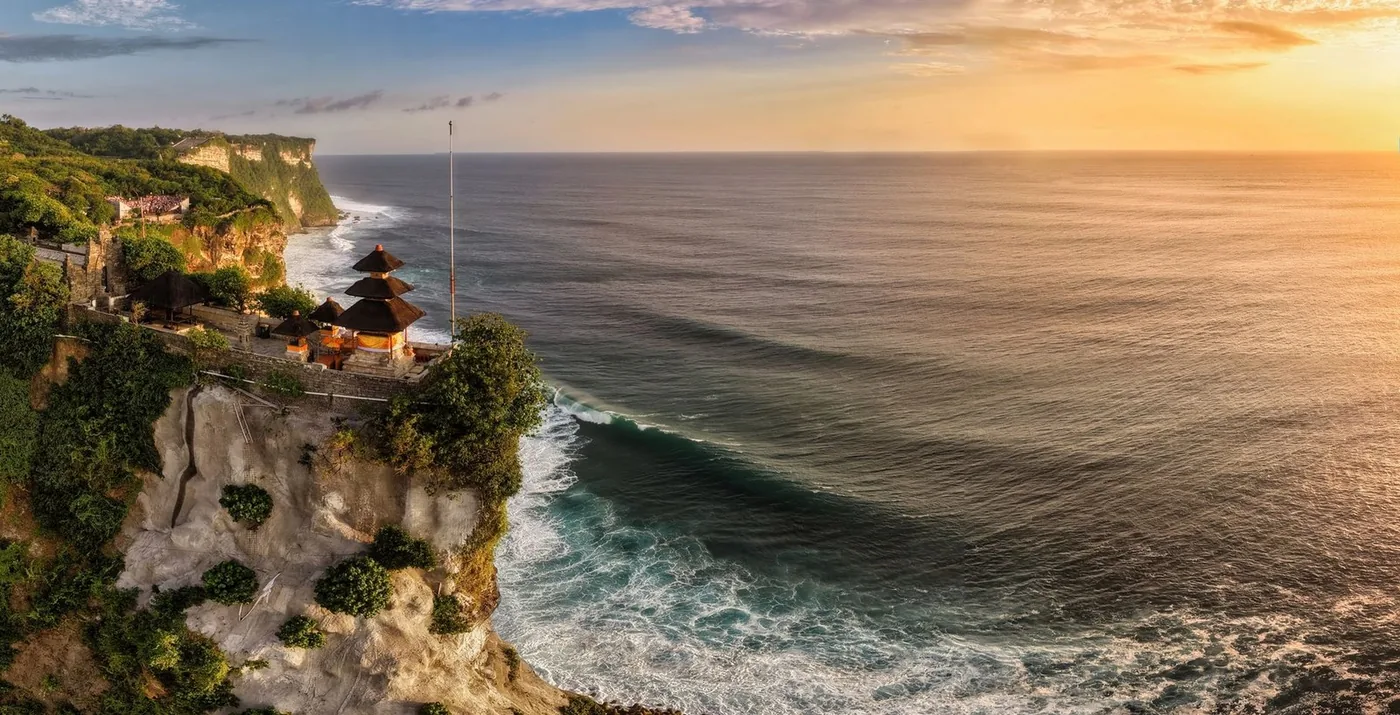
Pura Luhur Uluwatu stands on a limestone cliff seventy metres above the Indian Ocean at the south-western tip of Bali, and it is photographed several thousand times a day. Rather fewer visitors know that it is one member of a deliberate set, positioned as part of a defensive ring conceived in the sixteenth century, and that its location is an argument rather than a view.
The sea temples of Bali — Uluwatu, Tanah Lot, Rambut Siwi, Pulaki and others — are traditionally understood as a protective chain around the island, each within sight of the next, each guarding the coast against the malevolent forces associated with the open sea. The tradition credits much of the arrangement to the Javanese priest Dang Hyang Nirartha, who travelled the coast in the 1500s and is said to have attained release at Uluwatu itself.
That siting logic explains what otherwise looks like showmanship. These temples are not on cliffs because cliffs are dramatic; they are on cliffs because the boundary between land and sea is precisely where the protection was needed, and because each had to be visible from its neighbours. The spectacular photography is a by-product of a defensive scheme.
Balinese temple architecture is organised around a three-part division that becomes obvious once you know it. The outer courtyard, jaba, is the profane world where preparation happens. The middle courtyard, jaba tengah, is transitional, holding the kitchens and pavilions for offerings. The inner sanctum, jeroan, holds the shrines and is where the deity is received. Progress inward is progress toward the sacred, and at Uluwatu that sequence runs along a clifftop with the ocean on one side throughout.
The gates carry the same idea. The candi bentar, the split gate at the entrance, is a single structure cleft in two, usually read as the division of the world into opposing and complementary halves through which the visitor passes. The kori agung, the covered gate deeper in, is a genuine threshold with a door — the point at which access becomes conditional. Reading the gates tells you where you are in the sequence without needing a sign.
The material at Uluwatu is unusual and worth noticing. Most Balinese temples are built of dark volcanic andesite or soft paras stone; Uluwatu is built substantially of the black coral limestone of the peninsula itself, which weathers differently and gives the complex a hardness and pallor that sets it apart. The temple is, quite literally, made of the cliff it stands on.
Visiting well takes a little planning. Sarong and sash are required and available at the entrance. The macaques are numerous, bold and practised at removing sunglasses, hats and phones, and the only reliable defence is carrying nothing loose. The kecak performance at sunset is genuinely worth seeing and correspondingly busy; the temple itself is far better an hour or two earlier, when the light is still good and the crowds have not arrived.
The kecak performance at the clifftop amphitheatre deserves its reputation and a little context. It is not an ancient ritual but a 1930s composition, developed from the trance chant of the sanghyang ceremony and shaped into a retelling of the Ramayana partly with the involvement of the German artist Walter Spies. That does not make it inauthentic; it makes it a genuine piece of twentieth-century Balinese theatre, which is a more interesting thing to watch than a fake antiquity.
Uluwatu makes most sense as one stop on a coastal circuit rather than a destination in itself. Pura Luhur, the beaches at Padang Padang and Bingin, the fish grills at Jimbaran and, if the timing works, Tanah Lot further north, together tell the story of the sea-temple chain in a way a single visit cannot. Done in that order across a day, the siting logic becomes visible rather than theoretical.
The cliffs themselves are worth a moment's attention. This is uplifted coral limestone, the fossilised remains of a reef, raised by tectonic movement and then cut back by the ocean into the overhangs and caves that give the surf breaks their shape. The temple is built from the same material, which is why it looks as though it grew out of the headland rather than being placed on it.
Go at four rather than six if you can. The light is already good, the coach parties have not arrived for the performance, and you can walk the clifftop path along the temple wall with room to think. Whatever your beliefs, standing at the edge of a five-hundred-year-old wall above that particular stretch of ocean is one of the few things in southern Bali that is exactly as good as it is said to be.
What makes Uluwatu worth more than a photograph is that it is a working temple, not a monument. Ceremonies continue, the inner courtyard is for worshippers, and the odangan festival brings the surrounding villages up to the cliff. Standing at the wall as the light goes, it is worth remembering that the position was chosen for what the sea might bring rather than for what it looks like — and that five centuries of people have stood in the same place for entirely different reasons.